Welcome to Brett and Emily´s travel blog.

I promise I will finish updating soon...7 more post to do!

July 13, 2010: Banos updated (pics soon)

June 23,2010: Lima and Mancura are finished (in reality Mancura was already finished but I wanted to post them in order so I need to finish Lima) with pics

June 22, 2010: I know, I know...I have been home for a month and a have a lot to update from South America. Well the Amazon was updated today with pictures!

Tuesday, May 11, 2010

One Day along the Salkantay Trail Emily yelled at me for not taking enough pics of Flowers...this was my response

Don't worry this isn't our update about the Salkantay trail, just one evening along the Salkantay Trail (our trail to Machu Pichu) Emily yelled at me for not taking enough pictures of flowers.  So the next day I literally stopped almost every 2 minutes to take pictures of flowers.  Here is the end result...enjoy the 'prettiness!'


Arequipa, how we got sucked into a hostel for 4 nights!

So this is the story how we came to Arequipa for a maximum of two days and got sucked in for 4, all because of a hostel.

So we arrived to Arequipa in the evening after dark. The bus ride from Puno was around 5 hours.  When we arrived we walked outside to find a taxi. The hostel told us the ride should cost 6 Soles (U$D1=2.8 soles, two things about this comment is I love how the abbreviate the US Dollar in South America, U$D, second the symbol for the sol is S/.).  Well the guy at the taxi stand in the parking lot of the bus terminal told us 8 soles and then I noticed less reputable/cheaper looking taxis waiting out on the main street.  Low and behold it cost only 5 soles to get out to our hostel. When we received the directions to get to the hostel, it said the hostel was not in the middle of town but the place had pretty good ratings so we decided to go.  The drive from the city center was no more then 10 minutes but when we arrived it felt like we were in a different place.  This hostel was in a really nice suburb of Arequipa.  The hostel, Arequipay Backpackers, was brand new and only reopened about 3 weeks earlier.  Literally when we walked in to the hostel it felt like walking in to the living room of your rich friend's house whose parents have left for the weekend.  There was a huge billards table, large screen TV, brand-new kitchen, movie room with state of the art stereo and another flat screen, there was a room was a PS3 and a third flat screen, a swimming pool (which wasn't finished yet), a grill area, large backyard, and more.


Arequipa's Cathedral, with its massive intimidating White Stone Walls

Night #1
The next morning I woke up feeling pretty crummy (and well for the next 24 hours I was sick) and after a brief visit in to town with some fellow travelers from our hostel to visit the tourist information center, iPeru, I decided I didn´t feel like doing anything for the rest of the day so we headed back to the hostel and just sat a round watching movies and shooting pool all day...DAY NUMBER 1 WASTED.


The White Stone Archs that surrond the entire Plaza de Armas (except the Cathedral above), at night it is all well lit up and amazing
Night #2
The next day I woke up much more refreshed, unfortunatley Emily did not.  So the whole second day Emily spent  back in the hostel.  I decided to go out and see the sites around the city (which turned out to be only really two places) and look for a possible tour to go to the Colca Canyon.  I headed into town with the same people from the day before and first went to the famous Santa Catalina Monastery.  The monastery has existed since the 16th century and began as a monastery for wealthy families in Arequipa to send there daughters to become nuns.  Evidently, wealthy nuns knew how to party.  Monastery basically survived by the fact that all of the nuns who entered had large dowries paid for by their fathers.  They threw huge elegent parties, owned slaves (which was mostly forbidden in the Spanish Empire), and some even got pregnant.  Well during the 19th century the Pope heard about the problems at this monastery and sent a new head nun who reformed it and made extremely strict rules to follow.  The nun convent still operates today but the majority of the old monastery was forced to be open to the public in the 1970s.  The place is an amazing maze of colored streets (a small village inside the city) and courtyards.  With hundreds of bedrooms and other things people would need for daily life from the 1500s through the 1970s.  The rest of the day our group just went around walking through this 'white-city' (which we later heard was better then the white-city of Sucre, Bolivia, the constitutional capital of Bolivia. Which we chose to skip over because of time).  The rest of the city had gorgeous architecture that really displayed the wealth of the city through the ages.  The entire main city square (which throughout Peru the main city square is always called Plaza de Armas, compared to Argentina where the main city squares are always called Plaza de San Martin), which was named a UNESCO site, is a beautiful aray of white columns and arches dominated by the white stoned carved exterior of the city's Cathedral.  Several other building both churches, banks, and government officesthroughout the downtown have amazing white stone carved facades.  The city is truly amazingly beautiful and surronding the city are several (5 I think) volcanoes that truly dominate any outlook of the city.  The rest of the day was mainly spent either going for some Doner Kebab (what the Turk's call a Gyro, but in my opinion a lot better) and stopping by a cafe in the artisy district of downtown...SO DAY 2 COMPLETED, and a WASTE FOR EMILY.

Next is a selection of photos from the Monastery...


Sorry for the sideways photo the computer is not turning my photos

View from the top of the monastery over Arequipa and one of the 5 volcanos that surrond the city

Night #3

Day 3 in our hostel, aka Rich Friend's House, was the first day Emily and I were both feeling well enough t adventure out in to town togther.  We spent the afternoon just wondering around downtown so Enily could see the Plaza de Armas, the main square, and also exploring some other stuff like the riverfront and pedestrian mall.  The evening was like the past two evening spent being sucked in to the wonders of our hostel.  And making some pretty damn delicious Shakshuka (Also for you readers from Minneapolis, we also made some pretty damn good Jose's)!...SO THE THIRD DAY WAS A PRETTY PRODUCTIVE DAY IN AREQUIPA.

Amazing/Beautiful Stone Carved Facade of a Small Church

More Stone Carved Facades (this one is of a bank)
Night #4

Day 4 was actually spent doing what we originally intended to do Arequipa.  Heading to the Colca Canyon, which earlier in our travels had been recommended as a really cool place to go.  When we got to Arequipa we found out we had two options to do the canyon.  The first was to do a self-guided 2 day/1 night trek through the canyon and the other option was to go with a tour company out to the canyon for a day.  Well after Emily and I both got a little under the weather in back to back days, the fact we were starting to worry about time, and also because our next stop was going to be Cusco and we were about to start a 5 day trek anyway we decided to take the lazy way out and go on a day bus tour.  Needless to say we regretted this but in the ended we still got to see the canyon.  The hike if we would have done it would have been a 7 hour first day hike which ended in a descent in to the canyon and the next morning you ascend back up on the other side of the canyon.  The bus tour was much different.  We were picked up at 3am from our hostel and began a 3 hour bus ride along windy roads out to the Canyon.  After eating breakfast our next stop was to a famous spot where Andean Condors can be viewed every morning.    This in the end is what both Emily and I thought as the most impressive part of the trip.  Seeing the condors, both adults and children, soar over our heads was amazing.  Also because the condors don't really fly out of the canyon as much as float up from the hot air streams that go through the canyon they get really close to the viewing point and at points soar only a few dozen meters above your head or just in front of you.  Next we began a a bus ride to a series of miradors (lookouts) over the canyon.  The canyon is not exactly what we expected.  We were kind of suspecting much similar to the Grand Canyon (which even though neither of us have been to we have seen more then enough pictures and movies shot there).  Even though this canyon was twice as deep as the Grand Canyon, its about 1,200 meters deep, it wasn't spread out like the Grand Canyon is.  It looks much more like a river valley but is technically catagorized as a canyon.  It was pretty cool to see along the side of the canyon not only Inca Agricultural Terraces but to also see Incan graves which were (at least for the wealthy and royal) done in the canyon walls (or at other Incan sites we have witnessed along a mountain/hill side) by diggiing out a small cave and then enclosing it with adobe bricks.  They are all sitll visable today form the side of the road.  Besides the few lookouts we also stopped in two villages.  The first stop was to an extremely small village an impressive church.  The church like many other churches throughout several small villages in the Colca Valley was built by the Spanish to try to bring a dominate form of Christianity during Colonialism to the region which still to this day mixs both Catholicism and Incan/pre-Incan traditions.  They weren't to succesful but now adays thes giant impressive churches stand in the middle of every small 200 person village in the valley whose houses are not much more then adobe brick.  Most of the churches were actually badly damaged in an earthquake in the 1980s but have been helped rebuilt by private donations from Spain.  Our final visit and for a late lunch was to the largest village in the valley, Chivay.  The village is in the shallowest part of the canyon.  After having lunch we headed back 3 hours to Arequipa which after arriving at the hostel we relaxed a few hours before heading to the bus terminal to take an overnight bus to Cusco (we wisely pre-booked the bus ticket so we wouldn't get sucked in to the hostel for one more night).

Next is a selection of photos from the Condor look out (I have many more but these are my best shots)...


Following is random pictures from the rest of the Colca Canyon tour...

Lago in the middle of the Canyon


Great view of a large part of the canyon

Another great view of the canyon with Inca terraces everywhere


One of the dozen plus White Large churches the dot the canyon in every small village

The interior

Baby alpaca (its fur was really really soft) and a little girl in traditional dress

On our return trip to Arequipa form Colca Canyon with two of the snow capped Volcanos in the background


Overall our stay in Arequipa was really relaxed we knew we are in a rush to make it to Bogata, Columbia but I think we both needed the days to rest and we kind of just hit the right hostel at the right time.  For those who think it was only us being lazy bums and getting sucked in to this hostel, it is not true.  It was not only us that this phenominum was happening to but people we had also met at the hostel were staying up to a week and one couple 10 days if not more for truly no reason.  Just because this hostel was basically the perfect place to be if you needed a break.

Saturday, May 8, 2010

The Meat is running out in Argentina!

Just saw this article on Yediot Ahranot´s English Website.  And no, not according to popular belief Argentina is not low on its supply of beef because of me!

YnetNews.com: Sharp Meat Price Rise Expected

Lake Titikaka...The Peruvian Side

The bus ride from Copacabana to the border only took about 20 minutes.  After exiting Bolivia (the passport official didn´t give Emily anymore problems, though he did make kind of a disgusted face when he saw her American passport) we had to walk over the border to Peru.  When going through Peruvian passport control, I decided to enter on my US passport.  The border control guy kept looking through my passport three or four times (I thought there was a problem) before he looked up at me and asked if I had a second passport.  I said yes and handed him my Israeli passport, he was just looking for the exit stamp from Bolivia and completely understood why I had used two different passports.  We loaded on to a new bus and headed off another hour plus until we hit Puno.  Once we got in to Puno tending we didn´t have much time we quickly found a hostel and booked a relativly cheap priced tour for the next day to see the famous Uros Floating Islands.  We also got a great recommendation for some Chinese food in town, and had our first Chinese food since we have been in South America.  We have later learned that Peru has a very large minority population of Asians (mainly Japanese and Chinese immigrants), including one of their past presidents (who has since been convicted of human rights violations), Alberto Fujimori who is the son of Japanese immigrants.


Ghetto border crossing between Bolivia and Peru
The next morning we were picked up early and headed off to the port for our tour of the Floating Islands. The islands were pretty interesting/amazing/out of this world.  First I´ll begin why these islands even exist.  Around 700 years ago evidently a people called the Uros  were in a war with a neighboring people.  Well needless to say there enemies were a little stronger so in order to escape they built boats out of totora reed (which is everywhere in the Peruvian side of Lake Titikaka).  Well they began to live on these boats and from these boats they started to make islands which are completely made out of reeds.  By completely made out of reeds I mean they legit float and every couple of months or years (I don´t remember) they just need to puit a new layer of reeds on top (I think each island can last 15-20 years).  Well basically for 700 years now these people have been living on these islands.  Now a days there are 40 Islands which are all pretty small (no larger then 20 meters x 20 meters.  Only a handful of families live on each islands (according to wikipedia about 2,000 still live on the islands).  There entire lifes revolve around the totora reed, boats (even though we did see a lot of motor boats, I think the reed boats are mainly for tourists now), there houses, a large part of there diet is eating these reeds, and more. Our guide told us that about 60% of the islands (which for the most make a large oval) participate in tourism activities. He also said if there are ever disputes between families on one island that one or several families will literally just saw off their part of the island and float it (via boat) to either make it a new island or add on to an existing island. 

 One of the many floating islands

Everything is made out of reeds...no joke

They dressed Emily and I up in traditional clothing.  That i s the President of the island with us

Literally this stuff looked right out of a movie set, this is a picture of the fish pond in the middle of their island.  Also we learned the square built bouses only came along after colonialization.  Prior to this time their houses were normally circular.

The islands were pretty cool just to walk on.  They were really squishy but quiet comfortable. When we arrived on our first of two islands, the head of the island with the help of the tour guide explained to us a lot about their culture and also their connection with the reeds and how the islands are built and maintained.  In the middle of the island the have a fish pit where they raise fish: mainly trout.  We then walked around the small Island and they showed us several handmade goods (mainly woven stuff) which we did decide to buy one (because we need decorations for our new apartment in Ann Arbor!)  We then went over to the capital island (which really is not much bigger then any of the other ones).  Walked around for a bit and headed back to Puno.  Overall we spent just over 3 hours out and about.  In reality the islands we went to seemed really touristy in a way that the residents literally live off of the tourism.  It seemed kind of sad almost that they seemed only to keep their traditions in order to show off to the tourists.  It is pretty cool though how much  there lives revolve around the reeds.  The reeds grow naturally all around the islands and the islanders can just go and pick more when they need them.  But also at the same just seeing these things were amazing!  They are undescribable.

Several of the Floating Reed Islands in a row

About the average size of one island (the watchtowers on the island date back to the time the islands were built to make sure no one was coming to attack)

The reeds were so squishy to walk on (on a good note when they put several of the islands together to play soccer there a few injuries when people land hard on the pitch)

Several Islands in a Row

A view of t he bay where all the Islands lay, the buildings  you see in the background are more islands not the main land.

Back in town we decided to wait and catch a bus around 3pm.  So we shopped around a bit (Emily bought some alpaca wool socks) and had lunch...a Peruvian called Ceviche which is a soup of white fish, limes, and chili pepper that was delicious.  As there was not much to truly do in Puno itself we were more then content to get out of there after 24 hours.  We arrived at the bus station around 2:45 and there was a 2:30 bus that hadn´t left yet so we hoped on it and made our way to Arequipa.

Wednesday, May 5, 2010

Lake Titikaka...The Bolivian Side

We arrived in Copacabana, Bolivia on the shores of Lake Titikaka (3,800m above sea level) on Friday in the evening. After a semi-long exhaysted look for a hostel we decided to stay at a cheap hotel with a semi-good view of the Lake.  Copacabana is a kind of small town that has two main squares.  The first main square which is a lot less touristy is dominated by a huge Cathedral, the Basillica of Our Lady of Copacabana, that almost seems out of place in this small lakeside town.  The building has large dominating white walls and a large courtyard that almost reminds you more of some mosque complexes in Moracco (the architecture I assume had a large influence from Spanish colonial architecture) then actually being in Bolivia.  The second main square which is closer to the Lake, is completely for tourists.  Almost every storefront in this square is filled with tourist agencies trying to sell bus tickets throughout Bolivia and Peru, boat trip and tickets to Isla del Sol, or other touristy needs.  This doesn´t only continue throughout the square but all the way down the main road towards Lake Titikaka.  The only difference being on the main road compared to the plaza is instead only every other building is a ´tourist agency.´  The other ones are either super-expensive gringo resturants or hostels.  The problem that we discovered in the 3 places we visited in Bolivia is that many of the gringo/tourist resturants throughout the country are the only options for a true vegetarian menu.  As compared to being able to go eat at food stalls for 5-15 bolivianos (75 cents-$2.15) or at the chicken places for 10 bolivianos ($1.50), the gringo resturants usually charge between 30-40 bolivianos for many of there dishes ($5-6).  I know in reality it doesn´t sound like much, but compared to the other eating options it is pretty expensive.  Because of this the other funny thing is, that throughout Bolivia it is cheaper to eat meat then to eat vegetarian.  Anyway, all in all we were pretty unimpressed my Copacabana.  As there is really not much to do there and it is just so enthronged with tourist agencies.  Before we headed back for the night we enjoyed at the town´s market (which was filled with small drink stalls) Purple Chica, which here was served hot with spices but can also be served cold without spices.  The drink is made from a purple corn native in the region and like acai in Brazil areally does wonders on your valve movements. 


Sunset over the shores of Copacabana, Lake Titikaka


The Basillica of Our Lady of Copacabana, like many cathedrals in Bolivia and Peru it was built on religious ruins of the Incas


One of the nice ´touristy´ reed boats that our guide in Peru later called the BMWs of Lake Titikaka

Needless to say the next morning we woke up and took the next availible ´public boat´ to Isla del Sol (for 10 bolivianos we could take the public boat or for 140 bolivianos we could rent a boat with a driver, needless to say our budget is tight).  As we saw most tourists (mainly backpackers) get on different boats we kind of assumed we got on the wrong boat.  Luckly we didn´t though.  We got dropped off at the right place and later found out that we paid 10 bolivianos to go on the ´locals´ boat while most backpackers paid 20 bolivianos to go on the ´tourist´ boat.  After a bit over an hour boat ride we arrived at the Southern end of Isla del Sol, in the Yumani Community .  The island is mainly famous in Inca lore for being the birthplace of the Sun God and his son the first Incan, Manco Capac.  But overall the island is just an amazing beautiful place with good day hikes and Inca and pre-inca ruins.  The first day we got in not knowing where we were staying but knowing that the South end of the island was loaded with hostels.  The thing we didn{t realize was all of the places to sleep were way up the mountain.  And by this I mean we had to lug all of our bags up around 200 meters I would say to the top of the mountain.  About 3/4 of the way up we ran in to this little girl (no older then 5) who asked us if we needed a place to sleep (in spanish).  We started to follow her and we kept passing by several sleeping places until we got to almost the way top.  On the way we had asked other travelers who were looking for a place to sleep and they actually were going to the same place we were following the little girl because they said after checking 5 or so places that this was the cheapest.  So we settled in and with a large group of other travelers we decided to head off and watch the sunset over a light snack before heading to have the Lake Titikaka speciality, trout (which we later learned was introduced to the lake and is not native and of recent years they have been realizing it might have been a mistake).  The rest of the night we ust took it easy watching the gorgeous sunset and playing cards.


A random pack mule (which are heavily used on Isla del Sol) and Emily´s creepy smile

The snow capped Andes during sunset from Isla del Sol

Sunset

The next morning we woke up early and after enjoying our best breakfast in months (granola with yogurt, coffee/tea, and an amazing apple filled pancake) we decided to head off on a hike to the north side of the Island.  There is evidently a main trail that 99% of the tourists take along the spine of the islands mountain line.  Well needless to say we got a little lost and took a different route to the northside.  The route (which took about the same time, 3 hours) took us along the east side of the island both in the hills and on to the beaches of some small villages.  It was pretty cool seeing rural-island life and not just being in the two small towns on either end of the island which deals with the majority of the tourism on the island.  At one point we stopped for a snack on a beach in a small cove along the island.  And watched humerously as two traditionally dressed women and a man chased pigs around who found themselves enjoying a load of potatoes that had been left on the beach.  As we continued and finally hit the north end of the island we found the tourist area to pay the small 10 boliviano fee to enter the archeological area.  We started with a small museum, in the Challapampa Community, of archeological finds both on the island and from recent under water excavations near the island.  We then began a 45 minute trek out to see 6 highlighted.  Some were pretty simplistic as checking out the famous Incan farming terraces (piedra sagrada), an Incan temple, and what appeared to be a rebuilt alter (mesa de sacrificio).  Additionally, we saw the rock (Roca Sagrada) where the Incans believed the Sun God first appeared and finally the last stop was Incan ruins (Laberinto Chinkana) overlooking the west side of the island.  Most of the sites were pretty unimpressive until we hit the ruins.  Even though we saw some ruins north of Salta, Argentina, these were the first ruins we had seen that had not been rebuilt at all.   Overall though it was a great 3 hour hike out to the sites.  When we returned another 45 minutes we ran in to our friends from the hostel the night before. They told us they rented a boat for the day and if we wanted to hitch a ride with them back to the otherside of the island it wouldn´t be a problem.  We told them we heard there was a public boat at 4pm and it should give us enough time to get back to the hostel grab our bags get back down to the docks to go back to Copacabana and hopefully make a 6:30pm bus to Puno, Peru.  Low and behold there was no 4pm ´public boat´ back to the other side of the island (evidently the boat was at 2pm).  There were several boat operators who were willing to take us to the otherside of the island for 150-200 Bolivianos ($20-30!).  We said no thank you and decided to wait for our friends from the hostel to get back and hopefully hitch a ride with them.  When they finally returned around 4:30pm we tried to board the boat and offer the boat driver a little more for taking us two back with him.  He refused and in classic Bolivian Socialism, aka extortion, he refused to take us unless we paid off his buddy who we had refused a boat from earlier.  At the end of the day we had to pay the other boat driver 70 Bolivianos ($10) just to be able to get on a different boat.  Kind of sucked but it was that or hike 3.5 hours back in the nearing darkness.  By the time we returned to the South side of the Island we decided to just to stay at the same hostel for another night and get the 10:30am public boat back to Copacabana the next morning.

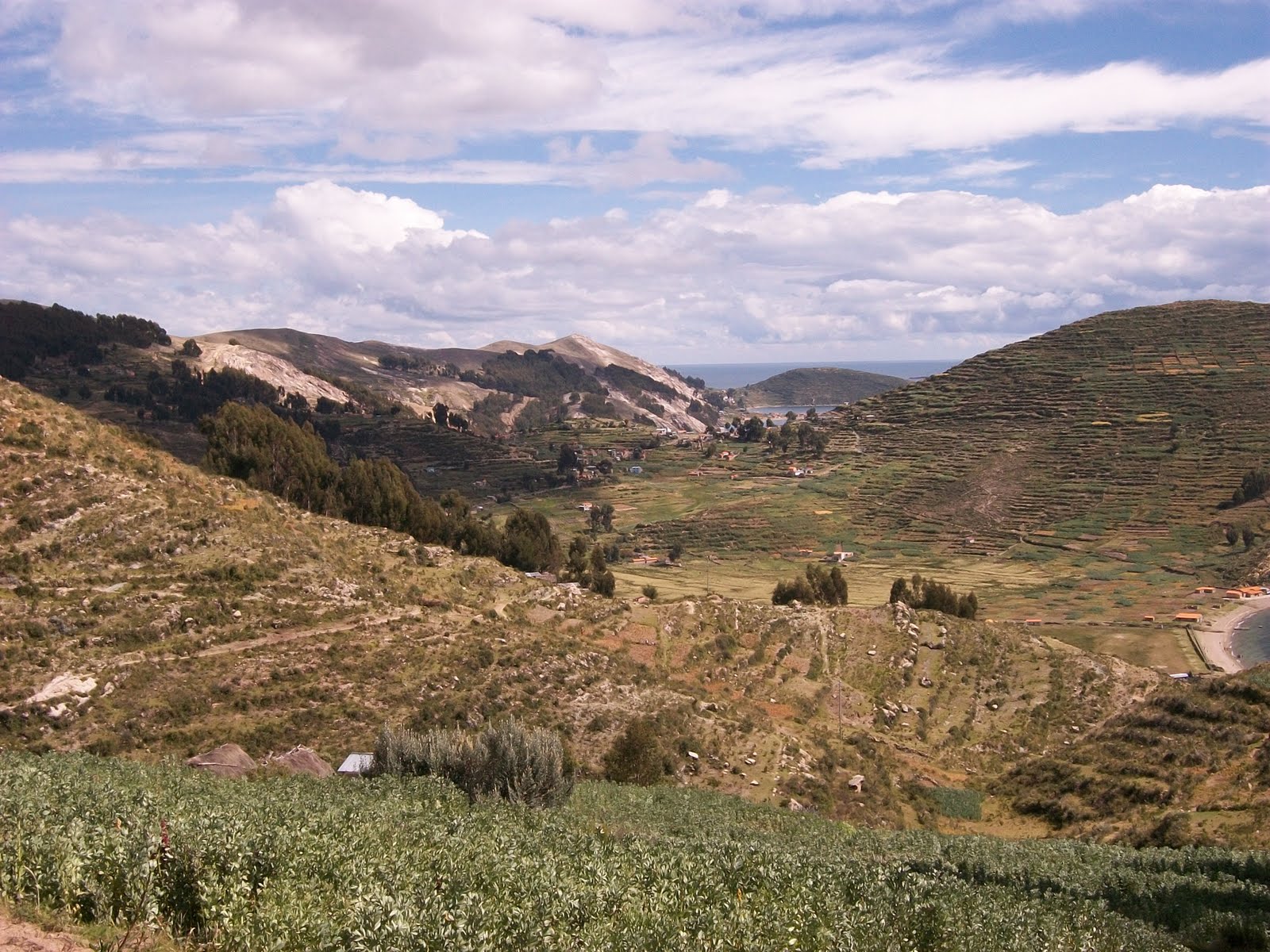
The terrain of Isla del Sol before our 3 hour hike

A baby sheep, Emily tried to kidnap it.

Overlook of a bay during our hike and a small village on the Island

Beautiful view of  the North Side of the Island and Challapampa

The ruins at Laberinto Chinkana and more sheep that Emily attempted to kidnap

Emily found an ´Emily sized door´

The next morning we woke up and took the public boat back to the mainland and caught a 1:30pm bus to Peru.