Welcome to Brett and Emily´s travel blog.

I promise I will finish updating soon...7 more post to do!

July 13, 2010: Banos updated (pics soon)

June 23,2010: Lima and Mancura are finished (in reality Mancura was already finished but I wanted to post them in order so I need to finish Lima) with pics

June 22, 2010: I know, I know...I have been home for a month and a have a lot to update from South America. Well the Amazon was updated today with pictures!

Wednesday, April 21, 2010

A Boy in Bolivia with Seth´s Photo

Brett will soon have the next blog posting up about our salt flats tour in the desert of Southwestern Bolivia, however in the meantime, I will provide a little story from that trip that is rather humorous.

During the jeep tour, we had a quick stop in a small village in the middle-of-nowhere on the second day. When we got out to stretch our legs, a group of really cute children cautiously approached the jeep. They were very curious about outsiders and also wanted to ask for candies, which one person on my trip obliged them with. We spoke with them a bit and they pointed out their school and told us that there were 10 children in the school.

I like to travel with some photos of family and friends on hand, so I pulled them out to show to the kids. One little boy took a great liking to a photo of my brother, Seth. The picture is a goofy one that I really like because it makes me laugh. The boy took it and kept looking at it and refused to show it to the other kids. So someone on my trip who is good at Spanish helped me tell him that he could keep the photo, if he let me take a photo of him to give to Seth as a trade. So here is the photo of a random boy in Bolivia who has Seth´s picture.

-Emily


Thursday, April 15, 2010

A wrap up of Argentina (and our side trips in to Chile and Uruguay)

So like I did for Brazil I want to give a bit of a wrap up about our time in Argentina (and like I said in the title of this post, ¨...our side trips in to Chile¨).  For starters we were only planning on staying in Argentina for maybe a month total.  Well a month turned in to 6 weeks and we enjoyed every moment of it.  As Emily said, ¨We loved Argentina, and think everyone should go there now!¨  The country had such amazing diversity of the land.  We were able to do everything from the Iguazu Falls (and my two side trips into Ciudad del Este, Paraguay), hands down the most amazing natural wonder I have ever seen, in fact it is one of the finalists for the ´7 Natural Wonders of the World´ competition.  Next on to Buenos Aires (and our day trip to Colonia del Sacremento, Uruguay, which was hands down a taste of Europe for under half the price.  Then for the long jounrey through the beauties of Patagoina, so many cities and things to mention: Ushuaia (penguinos and getting engaged!), El Calafate (glaciers!), El Chatén (trekking), and Bariloche (the Lakes District and riding a moped!). Next up to Mendoza and the biking winery tours.  Finally, on to Salta which was a whole different world in itself.

As for Chile, we do heavily regret not being able to do more of Chile.  Part of it was time, but also a large part of it had to do with very little news on the conditions of parts of Chile after the earthquake at the end of Febraury.  I did really want to check out both Santiago and Concepción but as both were heavily damaged in the earthquake we decided to pass over both cities and mainly only go in to Chile on side trips from Argentina.  Additionally, I wanted to part of the Carretera Austral, which is a 1,200+ km highway through Chile.  We did see advertised trips for 5 days to the ¨most popular¨ places along the highway (even though we also heard from people that it is an amazing month trip of hitchhiking).  Mainly because of time we skipped over this, but it did sound really exciting and everyone we met that did all or part of it said it was a great experience.  Minus what we skipped we did highly enjoy our side trips in to Chile (Puerto Natales/Torres del Paine, Aguas Calientes, and San Pedro de Atacama).  Most importantly for me, I enjoyed going to Chile so we could reload on Salsa Picante (Hot Sauce), which Argentinians really do not believe in (but that is a issue I will get in to a bit more).

As for the past 6 weeks, like I said it was amazing.  Here are some random tidbits about Argentina that we found really interesting.

1)  Maté-Really these people are pretty rediculous.  I first tried maté from my friend Liat in Israel whose family is Argentinian.  However, I really didn´t understand the national obsession until I got to Argentina.  The day we crossed from Brazil to Argentina (at Iguazu) we were at the National Park and every Argentinian tourist was carrying around his special maté cup/straw and a thermace with hot water.  We only realized that this obsession truly grew when at bus and reststops throughout the country we saw hot water machines (both free and pay) that you could refill your thermace.


2)  Porteños really think they are European-A Porteño is someone from Buenos Aires.  Like we have mentioned a million times, Buenos Aires is a European city in almost every respect.  Cafés, protests, architecture, and so much more.


3) Argentnian Assado-Simply Argentinian Steak is the most amazing in the world...and sooooo CHEAP!  And even Emily got to try some kosher Argentinian Steak.  My personal favorite cuts were Assado de tira (short ribs), Bife de Chorizo (the most commonly found cut throughout the country), and Entraña (which even though it is named the entrails it is actually a cut of meat that just happens to be near the entrails).


4) Argentinian Food is Really Bland-Outside of the Assado of the country, they really aren´t to original.  Yes their baked empanadas usually filled with veggies were better then the fried ones we had through out Brazil.  But they don´t really beleive in creative salads or anything else.  However on a sidenote Chimichurri Sauce is delicious!  Emily is more then excited at the ability to eat loads of quinoa through Bolivia and Peru.

We are now off to the final portion of the trip (another six weeks to do Bolivia, Peru, Ecuador, and Columbia)

Culture Shock in San Pedro de Atacama

As our day bus pulled in to San Pedro de AtacamaChile I was expecting a bus terminal of sorts tending it is a major backpacker´s destination.  Well there wasn´t.   The drive from Salta, Argentina to San Pedro, Chile was about 7 hours, the begininning portion of the drive we went through much of the same area that Emily and I did on the tour of Jujuy the day before going through the mountainess desert and seeing loads of cacti.  Evidently (I was sleeping) the bus driver even stopped at the 7 Colors Mountain for people to take pictures.  After crossing the Argentinian-Chilean Border we had great views of our first salt flats, the Salar de Atacama.  It was pretty cool because the highway basically went straight through the salt flats and all around we saw white.  As we reached the outskirts of San Pedro we finally went through Chilean Passport Control (for some reason they decided to put it in town, 160km from the actual border, also as we later found out you go through the same passport control when going to Bolivia even though it is a good 100+ km from the Bolivian border).  When we finally arrived in town I was a bit confused and wasn´t 100% sure we were actually there.  The day before when I booked our hostel for San Pedro someone at the hostel emailed us and said they would pick us up from the Bus Terminal.  Well there isn´t really a bus terminal, it is more a large open dirt area in one corner of town with a sign that said ¨Terminal Municipal.¨

 Small soccer pitch with the volcano in the background

The first day in town we just walked around.  The town isn´t that big (wikipedia says under 5,000 people live there).  The only green in the entire city is a well maintained fútbol pitch.  The town has basically a main square filled with government offices and one main street (with a few side streets) which are filled with tour agencies for trips around San Pedro and also the 3 day excursions to Bolivia, resturants, and a few watering holes.  We began to search through companies just asking for prices for the trip in to Bolivia.  We also enjoyed a pretty good dinner, mentionable was Emily´s lentil soup.  She was pretty glad because in Argentina they don´t really believe in lentils or any other like dishes. 

 Moon Valley

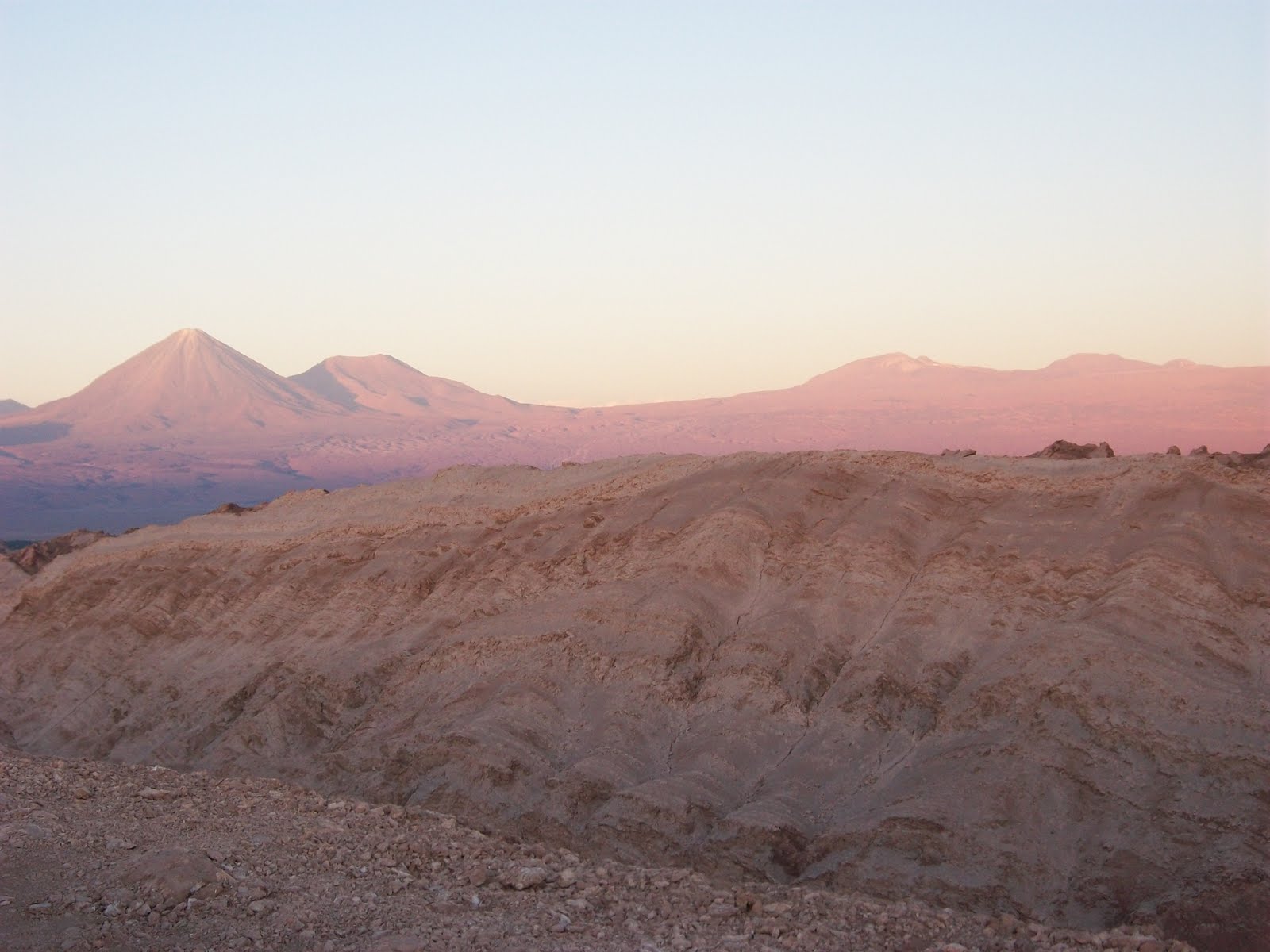
Friday morning we woke up kind of early for two reasons.  A) We needed to switch hostels, we only booked our place for one night and by the time we asked to book for another night the place was booked.  The owner was real nice and even drove us over to our new hostel with our bags.  B) We wanted to go in to town (by in to town I mean the one main street) and book the Salt Flats Tour in Bolivia before they all filled up for Saturday departures.  After finishing that all up it was basically only noon and we had no idea what we were going to do for the rest of the day.  After enjoying some delicious sandwiches (one with salmon and garlic sauce and one with goat cheese and veggies) we tried to figure out how to occupy the rest of our day.  We didn´t know much about the small excursions, through the Atacama Desert, that many of the tour companies offered around San Pedro.  Our roommate the first night woke up at 4am to go to a geyser field for breakfast with a tour agency.  As that wasn´t really an option because it was the afternoon now and we were leaving the next morning for Bolivia we decided to inquire about some of the other trips.  We found out from several agencies that there were basically two types of trips that leave at 3pm and get you back after sunset.  The first option which we chose not to do was a trip to a salt lake that was literally advertised by both tour agencies we went in to as being like the Dead Sea in Israel, next you go to hot springs to mainly clean off the salt, and finally you go to an overlook spot to watch the sunset (there was also additional options as of going sand boarding before the salt lake or after sunset going to one of the largest observatories in the world, that was built by Japan, USA, and the EU, to watch the stars.  The second option that we chose was a trip to several nature sites around San Pedro.  The first stop was Death Valley, which was a large valley which highly resembled the surface of Mars.  The original person to give the valley its present name (a European priest sometime the 1800s) actually named it Mars Valley, which in Spanish is Valle de la Marte, however the locals thought he meant Valle de la Muerte, which in English means Death Valley.   Our next stop was an amazing overlook of Valle de la Luna (Valley of the Moon).  Which like its name says resembles the surface of the moon.  We then entered Los Flamencos National Reserve.  In the Reserve we saw a salt crystal covered mountain valley, which was basically a huge valley that was once (thousands of years ago) part of a large Salt Lake in the region.  Now the entire dry river valley is basically covered in these salt crystals which where ever you go you can hear cracking.  The next stop in the Reserve was to three natural rock formations called the ¨Three Mary,¨ because they resemble three women caring for a baby.  Our last stop was to watch the sunset over sand dunes in the Reserve and once the sunset we were able to turn around and watch the changing colors on the Andes Mountains in the distance.  We returned to town after sunset and went to sleep highly anticipating our journey that in to the Slat Flats the next day.

 All smiles for Emily

Looking over the edge!

Sweet Salt Covered rock formations 

The whole side of this valley is covered in Salt Cyrstals

 The Three Marys Rock Formations

 View of the Andes Mountains (in the background) changing color during sunset

Wednesday, April 14, 2010

Salta: A city honestly we almost skipped over

As we had been planning our trip through Argentina, we have known for the most part what we were going to do in each place.  Yes, sometimes we learned more things about a place a day or two before from fellow travelers.  But when it came to Salta, in the Salta Province, we really knew nothing until a day before we left, when we learned from the group of American students we met during our wine tour of what exactly to do in Salta.  Before we learned this, we just kind of assumed it was just a place to go through on our way to Bolivia.  However in the end, like most things we  have done on this trip we were glad we went.

The entire downtown plaza had similar architecture

The city was much different then anything else we have seen in Argentina so far.  We read that once you start getting this far Northwest, you start to feel the influence of Bolivia and also the native population.  The first day in town we decided to explore the city itself.  The main highlights of the city were the main Cathedral (which had an interior that was bordering gaudy), the city square (which was heavily influenced by Spanish Colonial Architecture), and The Church of St. Francis (which its exterior was amazingly decorated both in color and stone carving).  After walking around the town we decided to head over to the cable car that woud take us up St. Bernardo Hill (which gives a great overview of the entire city).  When we got to the cable car there was a sign on the entrance saying that they will be closed for the next two days for repairs.  We had read in Lonely Planet that it was also possible to walk up the 1458 meter hill.  When we got to the begininning of the stairs to go up the hill, there was a sign stating that there were 1,070 stairs.  At first I thought about counting every single stair, but that in the end fell to the way side after about number 30.  As there were no indications of how far you were getting up the hill, the only way we were able to tell if we were getting close or not was along the path they had monuments depicting the story of the Crucifixion of Jesus.  The only problem was, we weren´t too fimilar with that one so it didn´t help us out too much. When we finally reached the top we spent a bit walking around and looking at the different views of the city.  The city was much larger then we expected.  After some time on the top we headed back down the 1,070 stairs and decided to go out for some pizza.  It was the first oppertunity we had to eat peace in a week plus because of passover (we did break passover the day before on the bus to Salta, we had purchased some bread before we left Mendoza). 

Cities main Cathedral (even more gorgeous inside)


Church of St. Francis at night and day

 Overview of Salta from atop (after 1,070 stairs)

The next day we woke up at 6am go on an all day tour of the villages north of Salta in the Province of Jujuy, which is one of the poorest areas of Argentina.  We spent most of the day in a minibus traveling from small village to small village along the Quebrada de Humahuaca.  It was completely different from anything else we have seen in Argentina.  The majority of this region (which borders both Bolivia and Northern Chile) is almost completely desert and mountains, and the population is mostly indiginous.  I´m going to give a short description of every place but like most things throughout South America hopefully the pictures can do better justice.  The first stop was to the town of Purmamarca (sorry no English wikipedia site), which was an extremely small town but at the same time had a feeling to it that made it special.  The streets were almost completely unpaved, all the houses were made from adobe bricks.  Next to the town is the Mountain of Seven Colors, which you can easily assume by the name is made up of several colors (they claim seven, but it is really only four I think with different shades).  We took some great landscape pictures and I finally got to see a real giant cactus (and gave it a hug, check out the pic).  Next we headed to an Incan Fortress called Pucará de Tilcara.  Even though we couldn´t tell how much of the site had been rebuilt for the purpose of tourism, it was cool seeing a small Incan town.  The site had several small houses, courtyards, communal areas, and a main ritual/sacrifice area.  After visiting the ruins we headed to the nearby village of Tilcara.  While we were there we were able to visit a musuem which is connected with the ruins.  They had on display artifacts from both the ruins and the entire region dating back thousands of years all the way through the Incan period.  It was a nice brief history and introduction to the Incan culture, which we know we will get a better taste of in Bolivia and Peru.  Also in the town was a huge market of woven and knit goods mainly from alpaca wool.  It was pretty touristy stuff, although some of it was nice, but we expect to see the same stuff throughout Bolivia and Peru.  At one village we stopped for lunch and I had my first experience with eating llama, I had a nice llama steak with quinoa, overall pretty delicious but tasted a lot like lamb.  We also visited a few other small villages, one in particular (I forgot the name of) had a small church which besides the entire alter being covered in gold, the seats and alter were all made out of cactus wood.  Overall the trip was a great expierence and really showed us a different side of Argentina outside of Buenos Aires and Patagonia.  Additionally, it gave us our first experience with altitude sickness.  The trip went all the way from 1,152 meters above sea level to well over 3,500 meters.  By the end of the day I felt a little light headed but nothing bad overall. 

 Mountain of 7 Colors

Hugging Cacti not always recommended (not as enjoyable as hugging Emily)

Incan Ruins (rebuilt)

That night when we got back to Salta, as it was our last night in Argentina, I went out for steak once again.  As always it was absolutley delicious and cost basically nothing (under $10 a person including a beer) compared to what someone would pay for this quality steak in the States (which honestly I have never had anything close to this quality in the states, not even a $40 sea salt encrusted prime rib).  The next morning we woke up and headed to Chile for the third time, leaving behind an amazing time we had in Argentina.  Honestly we were only planning a month in Argentina and it ended up being closer to 6 weeks, but I will write more about that in another blog about our overall experience in Argentina (and Chile).

Friday, April 9, 2010

One Day Wine Tasting and One Day Rafting = Two Really Awesome/Tiring Days

After a 20 hour bus ride, which we are quite use to these days (it is going to make my next 11 hour flight to Israel seem like nothing), we arrived in Mendoza, the wine capital of Argentina (and I´m pretty sure all of South America), in the Mendoza Province of Argentina. The city, even though a major tourist destination because of the vineyards surronding the town, did not have that touristy feel that Bariloche had (and that we didn´t like too much).  The city downtown was a nice wide-avenued place to walk around, with a few main streets, a pedestrian mall, and one major and 4 minor parks/plazas.  As we learned while reading lonely planet the towns streets and avenues are all built pretty wide because in 1861 the city was flattened by an earthquake. When they redesigned the city they decided to do so with the idea that if another earthquake occured, and the buildings collapsed again, that there would still be room in the middle of the streets for evacuation and making it easier for rubble to be cleaned.  As nice as the city itself was there truly is not a whole lot to do in the city besides walk around and enjoy the plazas.  I would have to say though that since Buenos Aires, Mendoza has felt the most European out of any of the cities we have been to.  

The second day in town we decided to head out to the wineries in the ¨Greater Mendoza Area.¨  There seemed to really two options when it came to the wine tours...either to rent a bike out by the vineyards and bike around doing a self-guided tour or to go on an organized van tour.  The van tours did go to a larger variety of vineyards, but they also seemed like more expensive places (hence taking a large chance of ending up with some snobby Frenchies on our tour).  So we took a bus, with a Danish and a Dutch girl staying in our hostel, from the city center out about 45 minutes to Maipú (which is the beginning of the bike-wine trail).  When we went to one company (Mr. Hugo, which we highly recommend, we will tell you why later) to rent bikes, as we were leaving they offered us helmets, to which the Dutch girl responded, ¨I´m Dutch, I know how to ride a bike!¨ So we peddled off to our first stop Museu del Vino-Bodega La Rural.  

We started here because first, it was the most northern point on the tour and second we thought it would give us a nice intro to wine tasting.  We are sure if we would have been able to understand the Spanish tour we would have received a good intro to wine tasting.  Unfortunatley, because it was Holy Week, there were more Spanish-speaking tourists then normal so English tours were not availible.  I was able to get a history of the Bodega (Spanish for winery) from my 4 years of high school Spanish that I don´t remember (you can read more about the history from the link above).  At the end of the tour through both winery and part of the vineyards they had a free sampling of one of their wines.  It wasn´t as much as a normal tasting as the basically just poured 60 glasses of their wine and everybody just kind of took one.  Trying to beat the crowds toward the nmext vineyard the four of raced out of the museum and headed down the street a few minutes to A la Antigua.  Besides wineries the area also has a few speciality shops that ¨specialize¨ in chocalate, liquors, and olive oil.  So for ten pesos ($2.50) we received a small tour explaining to us the process of olive oil making, the different types of olives they use, and then we got to sample lots of things.  The first thing they allowed us to sample were their olive oil and balsamic vinager.  This came to be a pretty large moral dilemma for Emily and I.  Since we wanted to experience the olive oil of this place we were about to break pesach by tasting the oil with bread, we thought to ourselves that keeping pesach for four days without even being able to eat matzah (because well we didn´t have any) was pretty good.  As we were reaching in to sample we noticed someone with a backpack full of matzah.  Assuming he was Israeli I went up to him and asked, in Hebrew, if we could have some to sample the olive oil.  He looked at me kind of with an astonished face.  Turned out thatr he didn´t understand Hebrew.  He was actually just from Buenos Aires, traveling around during a week off from classes (because of Holy Week).  He was more then happy to help us keep pesach by sharing his matzah and as the next few minutes passed by and we also tried jams, olive spreads, and sauces he just kept handing us more matzah.  Pretty much we were convinced that God sent him to us to make sure we kept Pesach (might make me sound crazy, but honestly what chances).  In addition to the spreads the place also made a wide selection of gourmet liquors.  We were allowed to sample a few so from the list of liquors we tried: Absinthe (I only had a bit, as one I have tried it before in Prague and two we had a long day ahead of us and didn´t want to start seeing any fairies flying around our heads) and a few different chocolate flavored liquors.

After a quick lunch with our friends near the olive fields, we hoped back on our bikes and headed towards the most Southern winery.  Lets just say the map the bike place gave us was a little deceiving with distances.  Yes it did hat it was only 12km, but biking from the most Northern to the most Southern tip of the map just took awhile.  As we began heading south and a more wide road with bike paths turned in to a tree covered road with little space between you and the speeding trucks, we enjoyed the great views of the vineyards going on for miles until hitting the foot of the Andes.  As long as the bike ride seemed atleast we had an amazing view.  We finally arrived at Carinae Vineyards.  This was probably the best of the tours that we saw, the tour guide gave us a nice history of the vineyard including that the owner took of the vineyards almost completly abandoned in in 1998, showed us the area where they barrel the wine and also their cellars where they age more of their select wines.  And in a true French kind of way, they promised us they only use French Oak and never would use American Oak to barrel.  At the end of the tour we sampled three of their wines (that were preselcted) which included their house speciality of a 60-40 Cabernet Sauvignon.


After we finished sampling we decided to head 2km north to the next winery, Famalia Di Tomaso.  When we arrived we waited for a bit for the next English tour.  We went through the wine tour, which was similar to the first one.  At the end because the group we did the tour with already did their tasting we got to do a tasting by ourselves (midway through two Frenchmen joined in also).   We tried 4 of their wines and then looked at our watch and realized we had about 20 minutes to bike to the last winery before it closed.  So we went outside looking for our Dutch and Danish friends who decided to order some food and were still waiting on it.  So we decided to hop on the bikes and bike to the final winery, Vina el Cerno.  We got there about 5 minutes before they closed up and they told us we could not do a tour.  Which we were for the most part fine with, because we pretty much got the jist of things during the three other tours.  But they did say it was fine to sample their wine.  This place we decided had the best wine tasting.  Instead of them just selecting 3 or 4 of their cheaper wines for us to taste (for 15-20 pesos) this place offered us any four of their wines for 25 pesos (they also poured a complete half glass for each tasting compared to a "tasting portion").  So we decided to try some of their more mature wines including a 2000 S-C, 2002 Malbec, 2006 S-C, and a 2008 Merlot.  We heavily enjoyed all four, and in the end even decided to buy the Merlot (best bang for its buck, aka cheap but still good). 


Even though all the wineries closed at 6pm, one of the chocalate and fine liquor places did not close until 7pm.  So after finishing our four-glasses we headed up to our final stop, Historias y Sabores.  The things that they made were pretty similar to the other Chocalate and Liquor place that we went to at the begininning of the day.  We sat outside with some American students, studying in Buenos Aires, that we had met at one of the other stops (we met them because two of them had their tandum bike stolen, by people who left their two individual rental bkes behind).  We sat there just chatting and sampling and getting some good tips about touring in Salta.  One curious liquor I taste tested was something I had seen at the other Speciality Store, Tobacco Liquor.  I decided to order it, and surprisingly it was delicious (Emily refused to sample it).  It basically just tasted like puffing on a really good Cuban and left no after taste or anything.  Finally they kicked us out of the place at 7:30pm and we headed back to Mr. Hugo´s to return our bikes.  When we arrived we were pleasently surprised by the fact that Mr. Hugo gave free wine to all of us already half-drunken customers.  So we sat around for a bit drinking and chatting with other travelers.  All in all it was a great/long day of drinking and as you can probably tell from the pictures of Emily and I, it was a day that just kept getting more and more tipsy. 

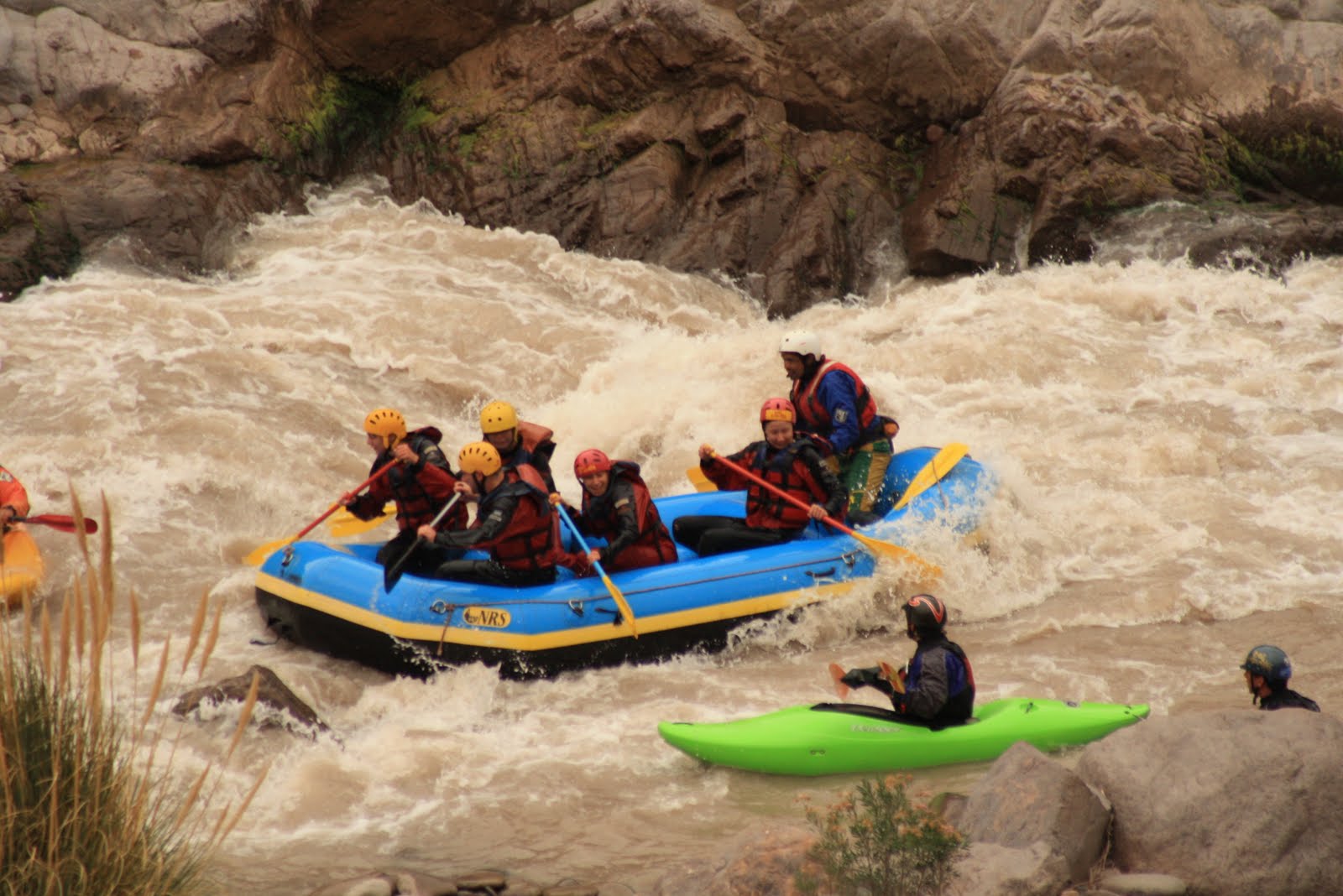
Our final day in Mendoza, we decided to take some advice of a friend that I went to Tel Aviv University with and we went rafting on the Mendoza River.  Unlike the day before which was a comfortable 60 plus degress and sunny all day.  The rapids were mainly Class 3 (during the Spring, they are probably Class 4).  This day was cold, real cold, and I´m pretty sure we didn´t see the sun at all.  This meant...cold water and no hot sun to dry us off.  Needless to say we had an amazing time (Emily has gone rafter several dozen times at her old camp she worked at, but it was my first time).  By the end we were pretty cold but it was hell of an experience.  While you are out they have a photographer on land taking pictures of every raft and after you can purchase the photos for your raft (it was like 40 plus photos).  So we decided to purchase it, these were a select few we chose.  Enjoy!


Monday, April 5, 2010

Hot Springs in Chile (which I guess is the exact opposite of my past post about Chile)

So as we had one more day to kill in Bariloche before we took a bus up to Mendoza we took some advice and headed to Chile (yet again) to go to Puyehue National Park which is semi-famous for three things: Volcanos, Hot Springs, and a 4 day long trek.  Well we decided to do the first two and because we recently finished a long trek we decided not to do the trek here.  As we only had basically a day we took a morning bus from Bariloche to the National Park, unfortunatley the bus didn´t stop at the place we wanted it to and we went an extra hour all the way to the city of Osorno, Chile.  We weren´t too impressed by Osorno (it is not really a tourist hub), but in the end it was good the hour or so we spent in the town because it allowed us to go grocery shopping at a supermarket in town (Chile has really strict rules about bringing in any fresh food products like veggies, fruit, dairy, and meat).  We hoped on a local bus which was pretty cheap and took the hour ride back out to Aguas Calientes (which literally means Hot Waters), which is the small  (and cheaper of three) spa in the national park.  Additionally this drive was pretty nice because we got to see several volcanos in the area which we probably wouldn´t have gotten to see otherwise (unfortunatley we don´t really have any pictures of the volcanos because we were in a bus).

When we arrived at the park there was basically three things at the entrance: the welcome center, the spa, and a refugio (look at the post about Torres del Paine if you want a better explanation of what a refugio is).  We looked at a park map and saw that there was a small camp grounds a few minutes up the road.  So we headed there, when we got there the place was completely empty and even though there was an office area it was completely closed and no one was around.  So even though there was a Park Rangers Station a few minutes away we just decided to setup camp and see what happened.  In the end we pretty much squated for the night. There were no other tents setup and no one ever came to see if any one was camping (12,000 Chilean Pasos saved=$24US).  We kind of assumed because it was not during the high season and a weekday they just did not care.    So after setting up camp we did a short hike up to a view point which allowed us to see the general area we were camping and the Puyehue Valcano.  We then returned back to the campsite and headed straight to the hot springs.  Since it was later in the day the outdoor hot spring was closing (it was cheaper) so we headed to the indoor spring and spent a relaxing 90 minutes just sitting in the hot pools.  The indoor spring was just a large swimming pool that had water from the springs pumped in to it.  We were pleasently surprised though that the water did not smell like ´egg water´ and basically had no odor at all which was different from both hot springs I have been to in Israel and Emily had been to in Montana.  Overall and I quote Emily, ¨We enjoyed them very much!¨

View from the overlook

 View of Volcano Puyehue from the overlook

The next morning we woke up around 6am to the sound of rain.  We soon realized we were camping in a large puddle.  When we finally garnered enough stregnth to wake up basically everything that was on the floor was wet including our sleeping pads, sleeping bags, tent bottom, and our hiking packs which were outside.  Basically we quickly packed up nthrowing everything which was wet into my pack and everything which somehow stayed dried into Emily´s pack.  We then headed to get a bus back to the main highway (where the bus was suppose to drop us off the day before) so we could get a bus back to Bariloche.  The bus finally showed up a bit late and we headed back to Argentina.  One funny thing that happened was when we were going through Argentinian Passport Control, a drug sniffing dog took a liking to my bag.  I assume he just smelt something funky from all the wet stuff packed in to it.  When the Border Patrol Guard pulled my bag out of the bus to search through it I just wanted to tell him he really didn´t want to open it (but I decided that would look suspicious).  So in the end I just felt bad for the poor guy while he went through my entire soaking wet pack.

In the end we arrived back in Bariloche with about 2 hours to spare before our bus to Mendoza.  So we basically retied some soaking wet plastic bags and allowed some of our stuff to dry.  Fortunatley when we arrived in Mendoza (20 hours later) we were able to dry everything out without anything getting moldy!

Sunday, April 4, 2010

Passover with a 1,000 Israelis (and one hell of an annoying American kid who happened to sit next to us)

A few weeks ago I sent an email to both Chabad Bariloche and Chabad Mendoza asking what their Chabad Houses were doing for Passover (Pesach in Hebrew).  For those who don´t know what Chabad is you can read about them on their wikipedia site or main webpage.  However in a quick brief for the purpose of this story, they are a strand of Orthodox Judaism which does a large amount of outreach work around the world, including providing different services for Jews who are traveling and away from their usual community.  The two responses I received were basically around the lines of this.  Bariloche said this will be a large seder as we are expecting between 700-1,000 people (99% of them being Israeli).  Mendoza said this is a small community seder around 50 persons (most Jews that live in Mendoza work in the wine industry at kosher vineyards).  So as we could have made it to either location we chose to go the route of most of the Israeli travelers we met and signup for the seder in Bariloche.

The day we returned from camping in Nahuel Huapi National Park (which was the  day before the first seder) I headed down to the Chabad House in town (which was conveniantly near the main street and also hard to miss as they had a large menorah in the front yard).  As I waited in line to signup and pay for the seder with a bunch of other Israelis all around the house people (a lot of Israeli volunteers, with Chabadnikim from Bariloche, Buenos Aires, and Israel supervising) were cutting a preparing veggies.  Literally every corner of this house (which was not that large) was covered in large plastic buckets full of veggies (some already mixed for salads, others still needing to be cut, and some that just hadn´t been touched yet).  After I paid and got a small lecture about the security procedure for the next night, I headed back to our hostel pretty curious about how a seder of this size would run (besides many Jewish sites around the world normally have security, in Argentina things have been pretty tight since the Israeli Embassy in Argentina was bombed in 1992 and the Jewish Community Center in Buenos Aires was bombed in 1994. Additionally because one of the sites of the mass terror attack in Mumbai in 1998 was a Chabad House, Chabad has brought in additional security during large events like a Pesach Seder).

The next night around 6:30pm we went searching for the location of the seder.  We found the location pretty easily (it was in Bariloche´s Sports Arena) mainly because of the large crowd of Israelis smoking outside and the street was also blocked off with police guards.  We went through the security check, which even though looked like a standard ELAL security check was actually much less intimidating and they only asked a like two questions and they looked at your passport.  So we headed inside and immediatly were shocked by the size.  We constantly heard for the past few weeks anytime we saw Israelis that it was going to be around 1,000 people but it is just pretty funny to actually finally see it.  The entire seder was setup on the basketball court with a small leveled stage in the middle for the rabbi to lead the seder and 20 or so long tables which could each fit 40+ people.  We apologize for no pictures of the event, we considered bringing a camera but weren´t sure if they were going to allow it through security and also because it is a Yom Tov we didn´t think we were going to be able to take pictures anyway.

Picture I found online of the Seder in Bariloche last year at the same place (it was setup a little different, but you get the idea)

We ran in to an Israeli couple we had met in El Chatén a few week earlier and sat next to them for the seder.  Additionally, Emily thought she was going to be the only American at the seder, but by random luck another American kid from Miami/New York sat next to us.  The kid was pretty annoying in that New York Jewish type of way.  The hagadot were in Hebrew and Spanish only, and the entire seder was in Hebrew (as 99% of the participants were Israeli).  It was kind of funny to see though, that there weren´t only Israeli post-army travelers at the seder many people had their parents and younger siblings actually fly in to Argentina for passover (in Israeli schools kids get off a week or so for Passover, it is kind of like their Spring Break, so many Israelis actually leave Israel and travel during Passover which is pretty ironic when at the end of the Passover Seder you say, ¨Next Year in Jerusalem¨).

Overall, the seder was for sure an experience.  The rabbi at Chabad Bariloche probably won´t have a voice for the next month, about a quarter of the way into the seder he needed an Israeli to begin shouting what he was saying (additionally trying to get several hundred Israelis to all be quiet at the same time is a pretty hard task that I have only seen certain NCOs in the IDF be able to do).  A large problem during the seder was they had very little serving staff so anytime food needed to be passed out it took 30 minutes or more.  Additionally, some one was not thinking and all the wine had corks in the and nobody had cork screws (the wine was all Argentinian Kosher for Passover Wine from Mendoza).  However, in the end of the day people started passing around batteries or other objects that would push the cork down into the bottle (real classy, I know).  The seder finally finished around midnight or so, with only about 30% of the original group still present.  The remainer did the traditional Passover songs: Echad Mi Yodeh? (Who Knows One?), Chad Gadya (that´s right there is a wiki site for Echad Ni Yodeh and Chad Gadya), etc.  Don´t worry the seder was complete with both regular matzah and shmor matzah, however no matzah ball soup or gefilta fish.

Friday, April 2, 2010

Cruising a Moped in Bariloche

After along 29 hour bus arrived we arrived in Bariloche in the Rio Negro Province of Argentina.  The first day we just spent like usual getting to know the town.  We instantly noticed (and were previously told) that the town is extremely touristy.  The entire downtown area is expensive restuarants, chocolate shops, and touristy gift shops.  The town needless to say was extremely expensive, and unlike other towns that we had been to that were also very touristy this one did not seem to have a cheap side to it (or even things really geared for backpackers).  Either way, one pleasant thing we did notice was the landscape.  Bariloche in the northern part of Patagonia, which in both Argentina and Chile is known as the Lakes District.  Surronding the entire town is amazing panoramic views of mountains and lakes, literally every where.  And so that is what we did with our time in Bariloche was instead of spending all of our money on the ´touristy´ main street we headed out to the Lakes.

View of the city center and Lago Nahuel Huapi

View of Bariloche from the outskirts of town

The first day we took a tip from some friends we met during our hiking in Torres del Paine and rented a moped/vespa like mobile (in reality it was going to cost $P65 each to rent bikes, or we could just rent one moped for $P140, so we decided to save our legs a bit and pay the extra $P10).  So instead of the normal bike tours which drive you 20+km outside of town to this Regional Park we hoped on the moped in town, and once I got my barrings, headed out the 20km to the park.  There is a famous bike circuit called Circuito Chico, which we began doing once we hit the park.  We stopped a few times, once to do a nice 1:30 loop to a viewpoint where we enjoyed a picnic lunch, next a small but scenic lake (what a surprise a lake in the Lakes District), and last for an amazing overview of the entire area.  The views were absolutley amazing and differed so much from Southern Patagonia which is more made up of valleys that have been carved out by glaciers and less green compared to Northern Patagonia.  Overall the day was a success, after getting a little lost on a dirt road (which is quite difficult to drive a moped on), we returned the 20km back in to Bariloche and returned the bike.  We are proud to say we (more I, Emily sat on the back the whole time) didn´t crash the moped!  I probably didn´t help the life of the semi-automatic clutch with my driving skills but all-in-all no problems!

Figuring out directions

View of our lunch spot (and Emily munching away)
Breath taking view near the end of the Municipal Park

View with us on the bike so our mothers can see our smiling faces

 Us with helmets on so our mothers can breath better knowing we were taking safety precautions

The next day we decided to head up in to the National Park which is named after the Lake which borders the downtown, Nahuel Huapi National Park.  We took a city bus up above the town to Lago Gutiérrez, and just decided to campout for the night, my feet were still in the process of recovering so no major treks.  We enjoyed relaxing by the lake (no Brazilian beaches, but still beautiful) for the afternoon and after a repeat performance of our glorious culinary masterpiece of ´camping pizza´ we sat by a nice campfire (with firewood that I dragged a long distance) enjoying our boxed Argentinian wine (much better then you would ever think) and chocolate.  The next morning we woke up and made eggs and toast for breakfast (oh the joys of semi-car camping, when you don´t have to carry around 5 days of food with you) and we headed out to do a small little hike to a waterfall (which again is a bit of a let down after seeing Iguazu) and a great outlook of Lago Gutiérrez.  When we returned we really wanted to rent a canoe or kayaks, but when we went to the place by the beach they told us they do not rent out individual canoes and kayaks and we had to join a guided group (for a price more then we were willing to pay).  So disappointed (Emily was and I quote ´very angry´) we decided to head back down to town a bit early and take care of some errands in town.

 View from the rocky beach near our camp site overlooking Lago Guitierrez

Emily got scared when I started to climb up the side of the waterfall, so I came back down

The next day we spent planning our next move.  We had heard from some people at the hostel we were staying at that in the Lakes District in Chile there were some cool volcanos and hot springs.  So we decided to research it a bit and after visiting the town tourism office, talking to a staff member at the hostel, consulting Lonely Planet and gringo.co.il we decided to go book bus tickets for an overnight at Puyehue National Park in Chile.  But that and Pesach seder with almost a thousand Israelis will be talked about in the next post.

Great picture I took on a bus in the Lakes District